
Dienstag, 18. Mai 2010

Dienstag, 30. März 2010
Koert van Bekkum receives Dr. Theol. cum laude with dissertation on Joshua 9-13
Koert van Bekkum (whose dissertation defense was announced earlier on this blog) received his Dr-title in Theology with the highest possible honour at the Theological University of the Reformed Churches (Kampen) with his book From Conquest to Coexistence. Ideology and Antiquarian Intent in the Historiography of Israel's Settlement in Canaan. He offers a synchronic and a diachronic analysis of Joshua 9:1-13:7 in light of ancient Near Eastern historiography, he discusses the historicity of the text in light of archaeological evidence and shows in his concluding chapter how the text combines (reliable) memories of history and ideology in dealing with the issue of who succeeded Pharaoh in ruling Canaan (the Egyptian promise in Asia) and YHWH’s promise of the land to the Israelites.
Nederlands Dagblad published an internet article and a newspaper article on his graduation. His book is available through the internet archive of Dutch dissertations.
Nederlands Dagblad published an internet article and a newspaper article on his graduation. His book is available through the internet archive of Dutch dissertations.
Lezing: "Exodus, mythe of werkelijkheid?"
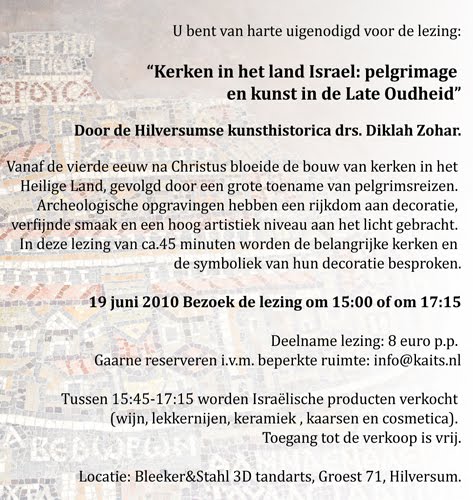
Op zondag 4 April 2010 verzorgt egyptoloog Huub Pragt in Hilversum een lezing over de Exodus, het Bijbelse verhaal van de Uittocht van het Joodse volk uit Egypte.
De Uittocht uit Egypte is een van de bekendste Oudtestamentische verhalen. Het staat opgetekend in het boek Exodus en beschrijft de opstand van het Joodse volk tegen het hardvochtige bestaan tijdens hun verblijf in Egypte. In een dialezing van anderhalf uur wordt een beeld geschetst over hoe Moses zijn volk wist te bevrijden van de Egyptische onderdrukking. Het is het verhaal over de plagen van Egypte, de doortocht door de Schelfzee en de tien geboden. Het Bijbelse verhaal zal worden geplaatst tegen een archeologische en historische achtergrond. Algemeen wordt aangenomen dat de Uittocht heeft plaatsgevonden tijdens het Nieuwe Rijk, de Gouden Eeuw van Egypte. Tijdens zijn lezing neemt Huub Pragt u dan ook mee naar deze roemruchte tijdsperiode met farao's als Ramses II en zijn zoon Merenptah.
De lezing wordt georganiseerd door de Nederlands-Israëlische stichting Kaits, naar aanleiding van de viering van Pesach. Dit Joodse feest dat zijn verwantschap heeft met het Christelijke Paasfeest. Tijdens Pesach wordt de Uittocht van het volk van Israel herdacht.
Plaats: Tandartspraktijk 3D, Groest 71 te Hilversum.
Aanvang: 16.00 uur.
Kosten: € 8,-.
Reserveren:info@kaits.nl
(uitnodiging ontvangen van Diklah)
De Uittocht uit Egypte is een van de bekendste Oudtestamentische verhalen. Het staat opgetekend in het boek Exodus en beschrijft de opstand van het Joodse volk tegen het hardvochtige bestaan tijdens hun verblijf in Egypte. In een dialezing van anderhalf uur wordt een beeld geschetst over hoe Moses zijn volk wist te bevrijden van de Egyptische onderdrukking. Het is het verhaal over de plagen van Egypte, de doortocht door de Schelfzee en de tien geboden. Het Bijbelse verhaal zal worden geplaatst tegen een archeologische en historische achtergrond. Algemeen wordt aangenomen dat de Uittocht heeft plaatsgevonden tijdens het Nieuwe Rijk, de Gouden Eeuw van Egypte. Tijdens zijn lezing neemt Huub Pragt u dan ook mee naar deze roemruchte tijdsperiode met farao's als Ramses II en zijn zoon Merenptah.
De lezing wordt georganiseerd door de Nederlands-Israëlische stichting Kaits, naar aanleiding van de viering van Pesach. Dit Joodse feest dat zijn verwantschap heeft met het Christelijke Paasfeest. Tijdens Pesach wordt de Uittocht van het volk van Israel herdacht.
Plaats: Tandartspraktijk 3D, Groest 71 te Hilversum.
Aanvang: 16.00 uur.
Kosten: € 8,-.
Reserveren:info@kaits.nl
(uitnodiging ontvangen van Diklah)
Donnerstag, 11. Februar 2010
Dissertation on Joshua 9:1-13:7: rethorics and archaeology
On March 18, 2010 Koert van Bekkum will defend his dissertation From Conquest to Coexistence. Ideology and Antiquarian Intent in the Historiography of Israel's Settlement in Canaan at the Theological University of the Reformed Churches, Kampen
Current research on biblical historiography concentrates on the relation between history and ideology. The ideological rhetoric of Joshua 9:1-13:7, combined with external evidence seems to falsify the historicity of these chapters. Scholars disagree, however, on the question when the texts were written and how their antiquarian interest and ideology should be related to one another. The thesis answers this question by using three methods: a synchronic and diachronic interpretation; comparison with ancient Near Eastern historiography; and a critical evaluation of recent developments in archaeology as regards the main sites and region mentioned in the text between Late Bronze II and Iron IIB.
Its most important result is the hypothesis that an early version of Joshua 9:1-13:7 describing a unified conquest of Cisjordan by Joshua and the people of Israel came into existence in Jerusalem by scribes educated to a scholarly level during the early first milennium BCE with help of Late Bronze memories.
Current research on biblical historiography concentrates on the relation between history and ideology. The ideological rhetoric of Joshua 9:1-13:7, combined with external evidence seems to falsify the historicity of these chapters. Scholars disagree, however, on the question when the texts were written and how their antiquarian interest and ideology should be related to one another. The thesis answers this question by using three methods: a synchronic and diachronic interpretation; comparison with ancient Near Eastern historiography; and a critical evaluation of recent developments in archaeology as regards the main sites and region mentioned in the text between Late Bronze II and Iron IIB.
Its most important result is the hypothesis that an early version of Joshua 9:1-13:7 describing a unified conquest of Cisjordan by Joshua and the people of Israel came into existence in Jerusalem by scribes educated to a scholarly level during the early first milennium BCE with help of Late Bronze memories.
Montag, 1. Februar 2010
PhD position The Jewish Revolt against Rome
The Qumran Institute at the University of Groningen (the Netherlands) is looking for PhD candidates for the project 'The Jewish Revolt against Rome: Religious Groups and the Shaping of Identities in First-Century Judaea'.
For more information about the Institute for Research into the Dead Sea Scrolls and Ancient Judaism click here!
For the job advertisement click here!
For more information about the Institute for Research into the Dead Sea Scrolls and Ancient Judaism click here!
For the job advertisement click here!
Donnerstag, 17. Dezember 2009
Boek: Tall Zar‘a in Jordan (2009)

Jan Dijkstra, Meindert Dijkstra, Karel Vriezen, Tall Zar‘a in Jordan. Report on the sondage at Tall Zar‘a 2001-2002 (Gadara Region Project: Tall Zira‘a), BAR Int.ser. 1980, Oxford 2009.
Afgelopen zomer verscheen het eindverslag van onze proefopgraving op Tall Zar‘a in 2001 en 2002. Deze tell is gelegen in het noordwesten van Jordanië, in het dal van de Wadi al-‘Arab, hemelsbreed ca. 6 km ten zuidwesten van Umm Qays (antiek Gadara). De ruïneheuvel is in eind 19e eeuw en in de 20e eeuw diverse keren door archeologen kort onderzocht en vermeld onder verschillende namen (Tell Zara‘a; Tell Zer‘ah; Tell Zer‘a; Tell Zerā‘a; Tell Zira‘a).
In 2001 begon een archeologisch onderzoeksproject op de heuvel. Het Biblisch-Archäologisches Institut van de Universiteit in Wuppertal (BAI/W) voerde toen een oppervlakteonderzoek uit, waarna ons team van de Theologische faculteit van de Universiteit Utrecht in 2001 en 2002 een proefsleuf groef om de stratigrafie te verkennen. Vanaf 2003 voert het BAI/W jaarlijks opgravingen uit, sinds 2004 samen met het German Protestant Institute of Archaeology in Amman, onder leiding van Dieter Vieweger en Jutta Häser.
In ons rapport wordt de ligging van de tell en het vroegere onderzoek kort beschreven. Daarna volgen de opgravingsresultaten (stratigrafie, aardewerkvondsten en stenen voorwerpen). Het boek wordt afgerond met drie interpretatieve hoofdstukken. Een hoofdstuk behandelt de functies van de opgegraven woonresten uit de Laatbronstijd II – IJzertijd I (13e-10e eeuw v.Chr.), IJzertijd IIB (9e-8e eeuw v.Chr) en de Laatromeinse en de Omayyadische tijd (4e en 7e-8e eeuw). Het tweede geeft een statistisch onderzoek waaruit blijkt dat door inventarisering van de gevonden profielscherven samen met die van de wandscherven per pottype al in een vroegtijdig stadium van de vondstbewerking de samenstelling van oorspronkelijke aardewerkrepertoires berekend kan worden. In het historische hoofdstuk aan het slot wordt het voorstel gedaan om de versterkte stad die in de Late Bronstijd op Tall Zar‘a lag, te identificeren met Gadara dat bekend is uit Oud-Egyptische topografische lijsten en historische bronnen uit de tijd van het Nieuwe Rijk; in de IJzertijd IIC is dan – samen met de bewoning - de naam Gadara verhuisd van deze tell heuvelopwaarts naar het terrein van het latere Gadara (nu: Umm Qays).
Jan Dijkstra, Meindert Dijkstra, Karel Vriezen
Abonnieren
Posts (Atom)